

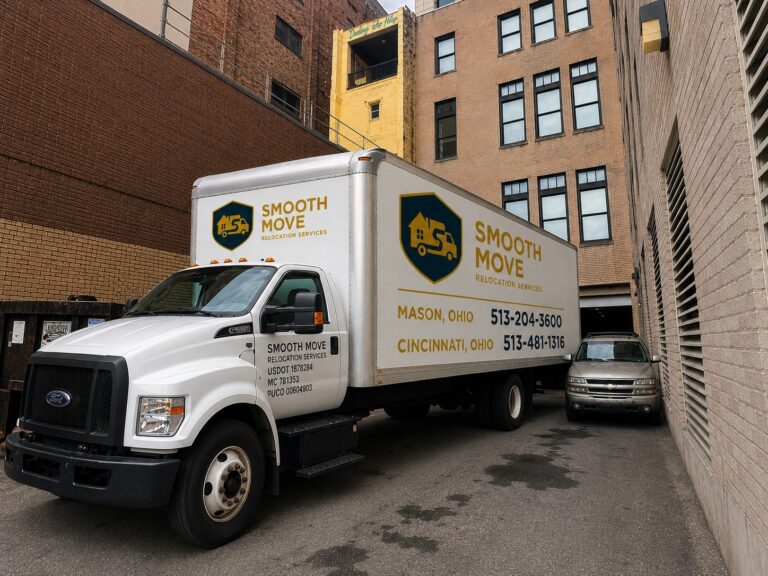
Two families call us the same week. Both have a three-bedroom home, about the same amount of furniture, and both are moving about 15 miles. One move takes five hours. The other takes nine.
Same stuff. Same crew. Same truck. The difference is everything between the truck and the front door.
After 25 years of moving people around Cincinnati, Mason, and Northern Kentucky, I can tell you the amount of furniture is only half the story. The other half is access: where the truck parks, how far the crew walks, whether there’s an elevator, how tight the hallways are, and what kind of furniture has to get through them. Those details decide how long your move takes. On an hourly quote, they decide what you pay.
That’s why, if your move has any of the situations below, you should ask for two things: an in-home estimate and a flat rate.
Why small delays turn into big bills
A move isn’t one trip. It’s dozens and dozens of trips back and forth between the house and the truck. Anything that adds time to one trip adds it to every trip.
Nobody’s doing anything wrong in that example. It’s just the building. But if you’re paying by the hour and nobody planned for it, you’re the one who pays for it.
The situations that make a move take longer
Elevators
Elevators seem like they’d make things faster. Sometimes they do. Often they don’t. A shared passenger elevator means waiting while residents come and go. Many buildings require you to reserve the elevator for a set window, and some want it padded before movers can use it. Then there’s size: a sofa, a tall headboard, or a long dresser may not fit in the cab and has to go down the stairs anyway.
Some buildings also have moving-day rules, like set hours, a loading area, or paperwork from the moving company. Find out what your building requires before you book.
Buildings and complexes with long walks
Apartment and condo communities are the biggest offenders. The truck parks in the lot, and the unit is down a breezeway, through a courtyard, around the back, and up a flight of stairs. It doesn’t look far when you walk it with a coffee in your hand. It’s a different story carrying a mattress for the fortieth trip of the day. If you’re moving in or out of a complex, see our apartment moving services.
Short driveways and no room for the truck
A 26-foot moving truck needs space. A lot of driveways are too short, too narrow, too steep, shared with a neighbor, or blocked by low branches or wires. When the truck can’t pull in, it parks on the street. That can turn a 20-foot walk into a 100-foot walk, and now you’re back to the math above.
Street parking on a hill
Cincinnati is built on hills. When the only place to park is a sloped street, loading gets slower and has to be done more carefully. A ramp set at an angle on a hill is harder and riskier to work. That’s one reason our trucks carry both liftgates and ramps. On a slope, a liftgate lets the crew raise heavy pieces to truck height instead of pushing them up an incline.
Parking in general
Sometimes there’s simply nowhere to put a truck. Busy streets, metered parking, permit zones, HOA rules, and apartment lots full of residents’ cars all play a part. In the city you may need a temporary permit to hold a space. We explain that in Cincinnati moving permits explained and street parking rules that can affect your moving day.
Tight or narrow hallways and stairs
Older homes, townhouses, and apartments often have narrow halls, tight turns at the top of the stairs, low ceilings, and small doorways. Getting a large piece through takes careful angling. Sometimes it means taking a door off its hinges, removing legs, or taking the piece apart completely. All of that is normal, and all of it takes time.
Specialty and oversized furniture
Some items take more time, more hands, or more protection than the rest of the house combined:
- Large sectionals and sleeper sofas
- King and California king bed frames, and adjustable bases
- Armoires, china cabinets, and tall solid-wood dressers
- Glass or marble tabletops
- Gun safes
- Pianos
- Pool tables
- Treadmills and home gym equipment
Put one of these in a narrow hallway or behind an elevator ride and it can take longer than an entire bedroom. Fragile pieces like glass tops and mirrors also need proper wrapping before anyone lifts them, which our packing services take care of.
A real example: fourth floor, downtown Cincinnati
One of our moves shows how this plays out: a building in downtown Cincinnati, a fourth-floor unit, and no elevator. It was all stairs, with a narrow hallway and a narrow stairway. Every piece of furniture had to be carefully worked through the hall and carried down four flights.
We sent four movers, and they had the whole load on the truck in three hours. With a smaller crew, that same load would have dragged on much longer, and those guys would have been worn out by the end of it.
A job like that isn’t about how much stuff there is. It’s about having the right manpower.
Why more movers can be the smarter choice
A bigger crew costs more per hour. That part is true. But a bigger crew also gets the job done faster. On a building like this, a crew that’s too small doesn’t save you money. It just stretches the job out.
There’s a bigger reason, too. Carrying a household down four flights of narrow stairs is hard, physical work. Put too few people on it and you’re asking them to overwork themselves. Tired movers slow down, and tired movers make mistakes: a scraped door frame, a dinged wall, a dropped piece of furniture. The last few hours of an overworked crew are when damage happens.
With proper manpower, the load is shared, nobody’s running on empty, and the crew stays careful from the first box to the last.
That’s one more reason to get an in-home estimate. When we see the building, we can send the right size crew for the job. With a flat rate, that crew is built into your price, so you know the total before moving day.
Why you should get an in-home estimate
An estimator standing in your home sees what a phone call misses: where the truck can park, how far the walk is, the elevator, the turn at the top of the stairs, and the furniture that’s going to need extra care. The price is built on your real move, not a guess about an average one.
We go deeper on this in why an in-home estimate is more accurate than a virtual estimate.
Why you should ask for a flat rate
With an hourly rate, every delay is your cost. The elevator wait, the long walk, the parking problem, the sofa that needs to come apart. The clock is running through all of it.
With a flat rate, you know the total price before moving day. The mover has already seen the job and accounted for the access, the walks, and the furniture. If the elevator is slow, that’s built in. You’re not standing in the hallway watching the time and wondering what the final number is going to be.
| Hourly rate | Flat rate after in-home estimate | |
|---|---|---|
| Who pays for delays | You | Built into the price up front |
| Know your total before moving day | No, only an estimate | Yes |
| Elevator waits, long walks, parking | Added by the hour | Already accounted for |
| Risk of surprise charges | Higher | Much lower |
To be fair, a flat rate is based on what you show your estimator. If you add a garage full of items that weren’t mentioned, or the situation changes, the price can change. That’s why the in-home estimate matters so much. Show everything, and the flat rate is the number you pay.
For more on spotting add-on charges in a quote, read how to read a moving quote.
What to show your estimator
- Where a large truck can park, at both the old and the new address
- How far the walk is from the truck to your door
- Whether there’s an elevator, and your building’s reservation rules and move hours
- Stairs, both inside and outside
- Narrow hallways, tight turns, and small doorways
- Every oversized or specialty item, including what’s in the garage, basement, and attic
- Anything that barely fit when you moved in
- Photos or a short video of the new home’s entrance and parking, if you have access
The bottom line
Your move is not a number of bedrooms. It’s a building, a parking spot, a hallway, and a few pieces of furniture that don’t want to cooperate. If your move has any of that, and most do, get someone out to see it, and get a flat price in writing. You’ll know what you’re paying before the first box goes on the truck.
Frequently asked questions
Why did my move take longer than the estimate?
Usually because of access, not the amount of furniture. Long walks from the truck, elevator waits, street parking, narrow hallways, and oversized pieces add time to every trip. When those details aren’t seen before moving day, estimates run short.
Is a flat-rate move better than paying by the hour?
For moves with elevators, long walks, tight parking, or large furniture, a flat rate is usually the safer choice. You know the total cost before moving day, and delays caused by the building or access don’t add to your bill.
Why do I need an in-home estimate?
An estimator can see things a phone call misses: parking, walking distance, elevators, stairs, hallway width, and oversized furniture. That leads to an accurate price, the right crew size, and a flat rate you can count on.
Do elevators make a move faster?
Not always. Shared elevators mean waiting, many buildings require reservations and padding, and large furniture may not fit in the elevator at all. Elevator buildings often take longer than people expect.
What happens if the moving truck can’t park in my driveway?
The truck parks on the street or in the closest available spot, and the crew carries everything from there. A longer walk adds time to every trip, so it should be accounted for in your price before moving day.
Do I need a permit to park a moving truck on the street in Cincinnati?
It depends on the street. In many city neighborhoods, a temporary permit is needed to reserve space for a moving truck. Check with the City of Cincinnati well before your move date.
Will movers take apart furniture to fit it through a narrow hallway?
Yes. Removing legs, taking bed frames apart, and sometimes taking doors off their hinges are normal parts of a move. It takes extra time, which is why tight spaces should be pointed out during the estimate.
Is it worth paying for more movers?
Often, yes. A bigger crew costs more per hour but finishes faster. On difficult jobs like upper floors, narrow hallways, and long walks, a crew that’s too small gets worn out, and tired movers are more likely to make mistakes. The right crew size protects your belongings and your home.
Can a flat-rate price change?
A flat rate is based on what’s shown during the estimate. If items are added or conditions change, the price may change. Show your estimator everything, including the garage, basement, and attic, and the flat rate is the price you pay.
Get a flat rate you can count on
Elevator building, long walk, tight hallway, or a sectional that barely fit? Let us see it. We’ll give you a flat price that already accounts for it. Call 513-481-1316 or request a free in-home estimate.
Smooth Move Relocation Services LLC | Serving Greater Cincinnati since 2000 | USDOT 1878284 | MC 781353 | PUCO 00604903
